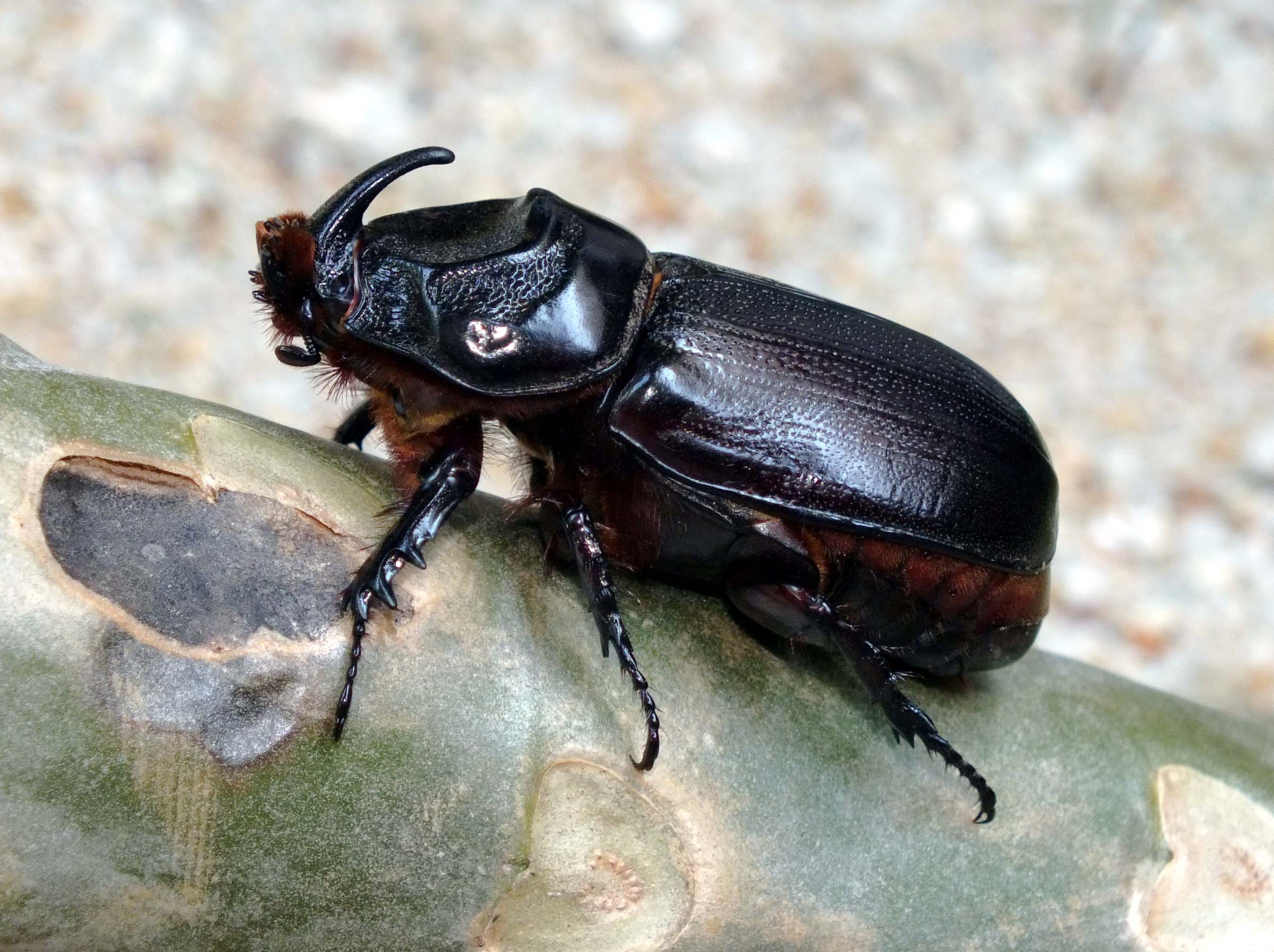
The Indian rhinoceros beetle (Oryctes rhinoceros) is one of the most fascinating and powerful insects found in tropical regions of Asia. Known for its impressive horn and strong body, this beetle belongs to the scarab beetle family (Scarabaeidae). It is widely recognized as one of the largest beetles in India and plays an important role in the ecosystem, although it is also considered a pest in coconut plantations.
The rhinoceros beetle in India attracts attention because of its unusual appearance and remarkable strength. These beetles can lift objects many times their own body weight, making them one of the strongest insects relative to their size.
Scientific Classification
- Scientific name: Oryctes rhinoceros
- Common name: Indian Rhinoceros Beetle / Coconut Rhinoceros Beetle
- Family: Scarabaeidae
- Order: Coleoptera
- Class: Insecta
This species is commonly called the coconut rhinoceros beetle because it often attacks coconut palms and other palm trees.
Physical Appearance
The Indian rhinoceros beetle has a distinctive and robust appearance that makes it easy to identify.
Adult beetles usually measure between 30–50 mm in length. Their bodies are dark brown to black, shiny, and very hard due to a thick exoskeleton.
The most striking feature of this beetle is the curved horn on the head of the male, which resembles the horn of a rhinoceros. This horn is used mainly for fighting with other males during competition for mating.
Key characteristics include:
- Large and heavy body
- Smooth, shiny dark brown or black shell
- Strong legs adapted for digging
- Curved horn in males
Females usually have smaller or no horns, which helps differentiate them from males.
Habitat and Distribution
The Indian rhinoceros beetle is widely distributed across South Asia and Southeast Asia. It thrives in warm tropical climates where palm trees are abundant.
It is commonly found in:
- India
- Sri Lanka
- Indonesia
- Malaysia
- Philippines
- Thailand
- Pacific Islands
Within India, the beetle is especially common in regions with coconut plantations and tropical vegetation, such as:
- Kerala
- Tamil Nadu
- Karnataka
- Andhra Pradesh
- Coastal regions
The larvae develop in decaying organic matter, including rotting wood, compost, and decomposing palm trunks.
Life Cycle of the Indian Rhinoceros Beetle
Like all beetles, Oryctes rhinoceros undergoes complete metamorphosis, which includes four stages.
1. Egg
The female lays eggs in decaying plant material or rotting wood. These environments provide a rich food source for the developing larvae.
2. Larva
The larval stage is commonly known as a white grub. The larvae feed on decomposing organic matter and can grow quite large before pupation.
This stage may last two to three months depending on environmental conditions.
3. Pupa
During the pupal stage, the insect transforms into its adult form inside a protective cocoon made from soil and organic material.
4. Adult
Adult rhinoceros beetles emerge fully developed with strong wings and the characteristic horn. They are mostly nocturnal insects, meaning they are active during the night.
Diet and Feeding Behavior
The Indian rhinoceros beetle diet varies depending on the life stage.
Larvae
Larvae feed mainly on:
- Decaying wood
- Organic debris
- Compost
- Rotting plant material
This feeding behavior helps in breaking down organic matter, contributing to nutrient recycling in ecosystems.
Adults
Adult beetles feed on sap from palm trees, especially coconut palms. They bore into the crown of palm trees to access the sap, which can damage the plant.
Because of this behavior, the beetle is considered an agricultural pest, particularly in coconut farming.
Agricultural Impact
The coconut rhinoceros beetle is one of the most serious pests affecting coconut plantations.
Adult beetles damage trees by:
- Boring holes into the crown of palm trees
- Feeding on young palm tissues
- Destroying developing leaves
Severe infestations can lead to:
- Reduced coconut production
- Deformed palm leaves
- Death of young palm trees
Farmers often use biological control methods and pheromone traps to manage beetle populations.
Ecological Importance
Despite its reputation as a pest, the Indian rhinoceros beetle plays an important ecological role.
The larvae help decompose organic material such as:
- Dead trees
- Fallen palm trunks
- Plant waste
This process improves soil fertility and nutrient cycling in forest ecosystems.
Thus, the beetle contributes to the natural recycling of plant matter.
Interesting Facts About the Indian Rhinoceros Beetle
- Rhinoceros beetles are among the strongest insects in the world relative to their body size.
- The male’s horn is used mainly for combat with other males during mating competitions.
- Adults are mostly active at night and attracted to lights.
- They belong to a group of beetles often called “giant scarab beetles.”
- Some rhinoceros beetles can live up to six months as adults.
Importance in Insect Study and Biodiversity
The Indian rhinoceros beetle is frequently studied by entomologists because of its unique anatomy, strength, and ecological role. It is also popular among insect enthusiasts and collectors.
Studying species like Oryctes rhinoceros helps scientists understand:
- insect evolution
- ecosystem balance
- agricultural pest management
These beetles are a fascinating example of how insects can be both ecologically beneficial and economically harmful.
Conclusion
The Indian rhinoceros beetle (Oryctes rhinoceros) is a remarkable insect known for its strength, distinctive horn, and large size. Found throughout tropical Asia, this beetle plays a dual role in nature. While its larvae contribute to the decomposition of organic matter, adult beetles can cause significant damage to coconut plantations.
Understanding the biology and behavior of this species is essential for both biodiversity research and agricultural management. As one of the most recognizable beetles in India, the rhinoceros beetle continues to capture the interest of scientists, farmers, and insect enthusiasts alike.
Leave a Reply